Hey there! If you’ve ever sat down with a 7-year-old who’s stuck on a 100-piece animal puzzle, whining that the lion’s head doesn’t fit anywhere, you’ve probably seen something cool happen. That kid doesn’t just fumble with pieces—they’ll turn to the sibling next to them, point at a corner piece, and say, “Hey, can you hold this? I think the zebra’s stripes match this edge.” Or maybe they’ll flag down Mom, explain in halting sentences what they need, and adjust when she points out a tiny detail I missed. As someone who runs an educational puzzles supplier, I get asked all the time: “What’s the big deal with these puzzles beyond just keeping kids busy?” Sure, they build fine motor skills, or teach shape recognition, but the real magic? They’re secret weapons for growing social skills—and that’s something we don’t talk about enough. Educational Puzzles
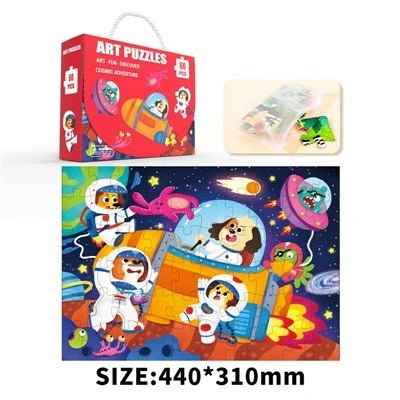
Let’s break this down like we do when testing new puzzle designs with the local elementary school’s special ed class. A lot of people think social skills are just “being nice” or knowing how to share. But research, not just my 10 years in this game, says it’s a mix of communication, collaboration, perspective-taking, and even handling small, messy conflicts—all stuff puzzles force kids to practice without them even realizing it.
First up: communication. When a kid is working on a puzzle alone, they talk to themselves, right? “No, that’s not the tree, dummy.” But when they’re with another person, that internal dialogue shifts. It becomes something they say out loud for someone else to understand. Last quarter, we sent a set of our 50-piece “Community Helpers” puzzles to a after-school program, and the teachers there wrote to tell me about Mia, a 6-year-old who’d never spoken more than two words to anyone outside her family. She was sitting with Javi, who was building the firefighter’s ladder. Mia pointed to a piece with a spark, paused, and said, “Fire. Up.” Javi looked at his ladder, said, “Top? Yeah!” And that was it—her first full sentence with a peer. That’s not a fluke. A 2021 study from the Journal of Applied Developmental Psychology found that collaborative puzzle play increases verbal communication in kids as young as 3, because they need to translate their mental picture of the puzzle into something another person can grasp. No textbooks, no role-playing drills—just two kids figuring out how to talk to each other to get one thing done.
Then there’s collaboration. Not the “split the toys, one for you one for me” kind of collaboration that’s more about division—it’s the messy, figuring out how to work together when no one’s job is clear. Our “Rainforest Expedition” puzzles are 200 pieces, perfect for 4-5 kids to work on at once. We design them so that no single person can finish a section alone. The jaguar’s spot pieces are tiny and hard to spot—one kid might be good at color matching, another at finding odd shapes. Last month, a teacher told me about a group that split up without even meaning to: Lila hunted for edge pieces, Ty stuck to the big animal shapes, and Zoe grabbed all the small, colorful bugs. When they got to a part where a butterfly piece was half-buried under a tree, Ty couldn’t find it, Lila was looking at edges, and Zoe was off picking up a different bug. They paused, looked at each other, and Lila said, “Wait, butterfly—Zoe, that’s not a bug, right?” Zoe held up the piece, smiled, and put it in. That’s collaboration, not just sharing. It’s noticing what other people bring to the table, and trusting that their skills matter. A 2018 study from the American Journal of Play backs this up: group puzzle play teaches kids to adapt their own strategy to fit the group, which is a core social skill they’ll use for group projects, sports, even work one day. And here’s the kicker—no one’s in charge. There’s no “leader” telling everyone what to do, so kids have to figure that out on their own. That’s way more effective than a teacher saying “work together” because it’s real—if they don’t, the puzzle doesn’t get done.
Perspective-taking is another big one, and I swear puzzles are way better at this than any game we’ve tried. Perspective-taking is basically being able to see things from someone else’s point of view, which is huge for not fighting with friends or understanding why Mom says no. Let’s take our 3D space puzzles for older kids, like the “Solar System Rover” set. It’s got pieces that fit together to make a tiny model of a rover, and some pieces only click in if you’re holding it a specific way. Last year, I watched a group of 9-year-olds put this together. One kid, Jake, was holding the rover from the front, trying to snap a wheel on from that angle. His friend, Maya, was looking at it from the side, and said, “Wait, if you turn it around, the hole is on the back.” Jake argued for a minute, but when he flipped it, the wheel clicked right in. That’s not just “being told”—that’s Maya seeing something Jake couldn’t because he was holding it wrong, and figuring out how to explain it to him. A 2020 study from Child Development found that kids who do collaborative puzzle play are better at understanding that other people have different visual perspectives, which directly translates to better empathy. If you can see why someone is stuck because their view of the puzzle is different, you’re more likely to listen when someone says they’re sad or confused about something else.
Of course, no social skill is perfect—kids will bicker, even over puzzles. That’s not a bad thing. Conflict resolution is another thing puzzles teach, and it’s way lower-stakes than a fight over a toy. Let’s say two 5-year-olds both want the same piece for their section of a dinosaur puzzle. What happens? They might yell, “That’s mine!” or “I saw it first!” But then, the puzzle is stuck. They have two options: walk away, or figure something out. Last week, the after-school program emailed me about exactly that. Two kids were fighting over a T-Rex tooth piece. The teacher didn’t step in—instead, she said, “Hmm, that’s tricky. What if one of you looks for another tooth?” Ten minutes later, the two were working together: one kid found a second tooth, the other took the first, and they snapped both into the T-Rex’s mouth at the same time. That’s not just sharing a piece—that’s solving a small conflict, and coming up with a compromise that works for both of them. A 2019 study from the Journal of School Psychology found that kids who engage in regular puzzle play are better at negotiating conflicts with peers, because they’ve practiced it in a low-pressure setting where the only “stakes” are finishing a puzzle, not hurting someone’s feelings.
Here’s what makes educational puzzles different from, say, a video game or a board game is that they’re unscripted. Video games tell you exactly what to do, board games have rules that tell you how to play with others. But puzzles? They just are a bunch of pieces that fit a certain way. There’s no rule that says you have to work with someone, but if you do, you’ll get there faster (and have more fun). That flexibility is key. We design all our puzzles with that in mind—some are for individual play, some for pairs, some for groups. Our “Community Garden” puzzle, for example, is 150 pieces, so it’s perfect for 3-4 kids, but even a shy kid can work on it alone while a few friends are there, and join in when they’re ready.
A lot of parents come to us and say, “My kid plays on their phone all day. Should I get them puzzles?” The short answer is yes, but not just any puzzles. Educational puzzles, not just the ones with cartoons on them. The kind that have a little bit of challenge, that make them stop and think, that let them mess up a few times. Because when they mess up a puzzle piece, they don’t get a “game over” screen. They just flip it over, look at it again, and try another spot. That resilience translates to social skills too—if they mess up a conversation or a group activity, they don’t have to quit; they can adjust and keep going.
Wait, let’s get real for a second. I’m not here to say puzzles fix every social problem. A kid who’s never had to talk to another kid will still need practice, and puzzles are just one tool. But they’re such a good tool because they feel like play, not homework. No one sits down to do a puzzle thinking “I’m gonna build my communication skills today.” They’re just trying to find the right piece, or finish the picture, and along the way, they learn how to talk to the person next to them, how to work together, how to handle a small fight, how to see things from another angle.
If you’re a parent, a teacher, or someone running a program for kids, and you’re looking for something that doesn’t feel like a chore to help kids grow these skills, our educational puzzles are made for exactly that. We’ve got sets for toddlers to teens, from big foam puzzles for little hands to 500-piece complex ones for older kids, all designed with that social play in mind. We work with schools, after-school programs, and families to find the right fit for their needs, no stuffy sales pitches, no hidden fees—just puzzles that actually do what we say they do.
If you’re interested in learning more about how our puzzles can support the kids in your program, or picking up a set for your own family, reach out to us to chat. We’re always happy to walk through our different lines, answer questions, or even tell you about stories from other teachers who’ve seen the same cool stuff I’m talking about. Don’t be shy—shoot us a message, and let’s figure out what works for you.
Puzzle References
- Journal of Applied Developmental Psychology. (2021). Collaborative Puzzle Play and Verbal Communication in Early Childhood Settings.
- American Journal of Play. (2018). Group Puzzle Play as a Framework for Peer Collaboration in Elementary School.
- Child Development. (2020). Perspective-Taking in Peer Interaction: The Role of 3D Spatial Puzzle Play.
- Journal of School Psychology. (2019). Conflict Resolution Skills in Young Children: Links to Structured Puzzle Play.
NINGBO LOTO PACKAGE MANUFACTORY CO.,LTD
Ningbo Sentu Art and Crafts Co., Ltd. is one of the most professional educational puzzles manufacturers and suppliers in China. With abundant experience, we warmly welcome you to buy high quality educational puzzles made in China here from our factory. If you have any enquiry about cooperation, please feel free to email us.
Address: 3rd Floor, Momi Community, New Jinfeng, No. 68, Chunchao Road, Yinzhou District, Ningbo City, Zhejiang Province, Ningbo, Zhejiang, China
E-mail: sales@nbprinting.com
WebSite: https://www.lotopuzzle.net/
