If you’ve ever stood on a factory floor watching industrial robots assemble electronics, or seen a conveyor system sort thousands of packages an hour, you’ve probably overlooked the tiny parts that make all that work possible. But here’s the truth: every single automated process, every sensor, every controller relies on connectors that are built to work in conditions most consumer parts would collapse in. For 12 years, I’ve been part of a small team that specializes in exactly one of those parts: the 0.60mm pitch connector for industrial equipment, and it’s time to talk about why this part isn’t just a component—it’s a make-or-break piece for the industries that keep the world running. 0.60mm Pitch

I didn’t start out as a connector guy. Back in 2011, I was an electrical engineer working for an automation firm troubleshooting factory lines that kept going down for no obvious reason. Every time we’d pull a part apart, we’d find the same issue: a connector that was too loose, too fragile, or just not designed to handle the vibration, temperature swings, or dust that industrial sites throw at them. One month, I spent three days on a line at a automotive parts plant, replacing connectors that had corroded after being exposed to metal shavings and coolant. After that, I started digging into industrial connector standards, and that’s when I stumbled on the 0.60mm pitch. At the time, most industrial connectors were 1.0mm or 0.8mm pitch, big enough for consumer electronics but too bulky for the compact controllers and sensors that new industrial designs were starting to use.
Let’s get one thing straight first: pitch in connectors is the distance between the center of one pin and the next. So a 0.60mm pitch means those pins are just over half a millimeter apart. At first glance, that sounds like a recipe for disaster. More pins packed tighter together means more chance of cross-talk, easier to short out, and way more precision needed during manufacturing. But for industrial equipment, that tightness is exactly what’s needed as machines get smaller and more complex. Ten years ago, an industrial PLC might have had 20 input pins; today, a compact PLC for small assembly lines needs 50, all in a space the size of a postage stamp. The 0.60mm pitch hits that sweet spot: it’s dense enough to fit high pin counts into small form factors, but not so tight that you can’t reliably manufacture, assemble, or repair it—unlike smaller pitches like 0.5mm, which requires specialized equipment most small industrial firms don’t have.
Over the years, I’ve worked with hundreds of engineers designing everything from medical device assembly lines to agricultural GPS systems that mount on tractors. I can’t count how many times someone has told me, “We’ve always used 1.0mm pitch connectors, why switch to 0.60mm?” The answer is twofold: space and signal integrity. Let’s start with space. A motor drive unit that used to measure 100mm x 80mm can now be shrunk to 70mm x 50mm using 0.60mm pitch connectors, which means more machines can fit into a single factory floor, reducing overhead. But space isn’t the only win. Tighter pin spacing means shorter trace lengths on the PCB, which cuts down on signal loss—critical for industrial equipment that needs to send data between sensors and controllers in milliseconds. If a conveyor sensor misses a millisecond of data, it can jam a line holding thousands of parts, costing a plant tens of thousands of dollars a day.
But here’s the thing about 0.60mm pitch connectors: they’re not a one-size-f-all part. The same tight spacing that makes them great for compact controllers makes them vulnerable if they’re not built for industrial environments. Early on, we saw a lot of imported 0.60mm pitch connectors that worked fine in a lab but failed within six months in a factory. Why? Because consumer grade connectors are built to handle room temperature and minimal vibration, while industrial connectors need to survive -40°C to 125°C, constant vibration from heavy machinery, dust, humidity, and even exposure to chemicals like oils and coolants. I remember one customer in the mining industry who tried a cheap 0.60mm connector for a sensor on a drill rig. Within three months, the pins had corroded from the mine’s humid, metal-rich air, and the drill had shut down mid-shift, costing them over $100,000 in lost production. That’s when our team doubled down on testing every 0.60mm pitch connector we sell. We don’t just run standard thermal cycles or vibration tests—we simulate the exact conditions our customers face: we blast test connectors with dust for 1000 hours, dip them in mineral oil for 72 hours, and vibrate them at 10G for 500,000 cycles, more than the average connector will see in 10 years of use.
What makes our approach different from other suppliers is that we don’t just sell connectors—we work with our customers through every stage of their design. Last year, a small team of engineers at a robotics startup came to us with a problem. They were designing a collaborative robot arm that needed to fit 48 signal pins into a 10mm x 5mm space, a requirement that standard 0.8mm pitch connectors couldn’t meet. They’d tried two different 0.60mm pitch connectors from big name suppliers, but both had signal interference when the robot moved, because the pins were too close together. We worked with their engineering team for three months, adjusting the pin layout and the insulation between pins to reduce cross-talk. When we delivered the test connectors, the robot ran flawlessly, and they were able to shrink the arm’s control module by 40%, letting them compete with bigger robotics companies. That’s the kind of impact 0.60mm pitch connectors can have, when they’re built and designed right.
Another thing I love about working with this part is how it’s adapted as industrial tech has changed. Five years ago, most 0.60mm pitch connectors were used for low-power signal connections between sensors and controllers. Now, with the rise of Industry 4.0, they’re being used for power and high-speed data too. Industrial IoT sensors need to send large amounts of data—like temperature, pressure, or vibration data—back to a cloud server in real time, which requires connectors that can handle high speed signals up to 10 Gbps. Our team has invested in specialized testing for signal integrity, using oscilloscopes to check for noise and loss at high speeds, so our 0.60mm pitch connectors work for both low-voltage signal and high-power applications. We’ve also added locking features that are critical for industrial use: our connectors have a spring-loaded latch that ensures they stay connected even during extreme vibration, and a blind-mate design that makes installation easy in tight, hard-to-reach spaces, like inside a machine where you can barely see the connector.
I get asked all the time if 0.60mm pitch connectors are here to stay, or if they’ll be replaced by smaller pitches. Right now, 0.5mm pitch is starting to gain traction for some ultra-compact applications, but it’s not a replacement for 0.60mm. The thing about smaller pitches is that they require more precise manufacturing, which means higher costs and higher failure rates for small to mid-sized manufacturers that don’t have specialized assembly lines. 0.60mm pitch strikes that perfect balance between density and reliability that most industrial customers need. Even as machines get smaller, the demand for parts that are easy to install, test, and repair means 0.60mm pitch will be around for years to come.
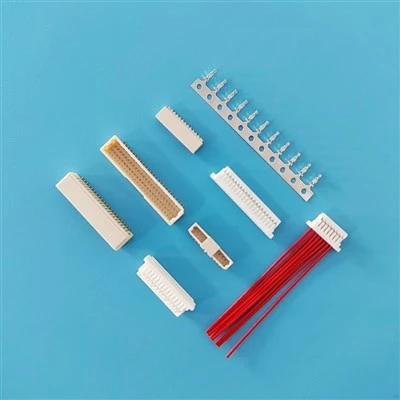
The industrial equipment space isn’t as flashy as consumer tech, but it’s the backbone of the global economy. Every time you buy a car, a bottle of water, or a phone, it was made by a machine that relies on small, reliable parts like the 0.60mm pitch connector. Over the last decade, I’ve seen how a bad connector can shut down a whole plant, and how a good connector can help a startup create technology that changes an industry. That’s why we don’t just sell connectors at our company—we solve problems. If you’re designing new industrial equipment, troubleshooting a line that keeps failing, or just looking for a reliable partner for your 0.60mm pitch connector needs, I’d love to connect and talk through your specific requirements. No sales pitch, no jargon overload, just honest advice based on 12 years of working with these parts and the people who use them.
1.20mm Pitch References
IPC-A-610, Acceptability of Electronic Assemblies
IEC 60603-13, Connectors for electronic equipment – Part 13: Detail specification for micro-connectors with 0.5 mm, 0.6 mm and 0.8 mm pitch, for board-to-board interconnections
ISO 16750-2, Road vehicles – Environmental conditions and testing for electrical and electronic equipment – Part 2: Mechanical loads
Dongguan Yinglian Electronics Co., Ltd.
As one of the most professional 0.60mm pitch suppliers in China, we have world-leading production equipment and strong manufacturing capabilities. We warmly welcome you to buy bulk high quality 0.60mm pitch at competitive price from our factory.
Address: No.12, Jidele Road, Juqi, Humen Town, Dongguan City, Guangdong Province, P.R. China
E-mail: James@csg-china.com
WebSite: https://www.csg-conn.com/
